When it comes to starting a crane load monitoring project, the first thing on everyone’s mind is rarely the first question that actually matters.
The question everyone asks is “what’s the right load cell for me?” The question that actually makes all the difference is “where is the load being measured on this specific machine?”
If you get the measurement point right, the choice of sensor usually narrows down to just a couple of options. But if you get it wrong, you’ll end up with a sensor that reads accurately but gives you the wrong reading, or one that just won’t physically fit, or one that has to be removed every time you change the rigging.
Start With the Measurement Point, Not the Sensor
There are five common places loads typically get measured on a lift, and each one leads to a different family of sensors.
- In a load-bearing pin: the hook block pin, a sheave pin, an equalizer pin. The load path already runs through it.
- In the rigging: between the hook and the sling, at a shackle connection point.
- In line with the sling or rope: a link carrying the tension directly.
- On the wire rope itself: measuring rope tension without breaking into the load path at all.
- Below the hook: where you want a weight readout more than a monitoring system.
A couple of questions settle which one applies. Is the sensor going to stay there all the time, or will it be used on different machines? And can you easily get to the load path and install or remove the sensor? On some machines you can just swap out a pin or add a link, but on a production crane that’s under warranty or already at its headroom limit, you can’t even think about it.
The Five Sensor Types, and When Each One Wins
Load Pins
A load pin replaces an existing clevis or sheave pin with one that has strain gauges built in. This is the strongest option for a permanent crane monitoring setup, and the reason is simple: it consumes zero headroom.
The sensor is where a pin already was. The trade off is lead time – each pin is custom engineered to the pin it replaces, so there’s no option to just pick one up off the shelf.
Load Shackles
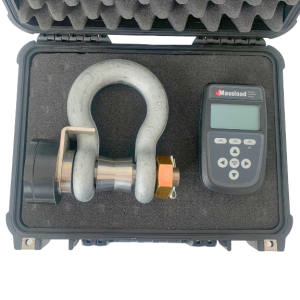
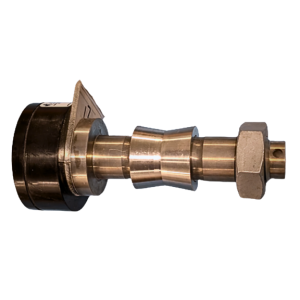
A wireless or wired load shackle is a shackle with the measurement built into the pin and bobbin. Massload’s run from 6.5 t to 85 t, with stainless steel pins and bobbins and rugged HDPE enclosures that can go anywhere – wired or wireless.
The big appeal is that riggers already know how to use these – there’s no procedure to learn.
Tension Links and Dynamometers
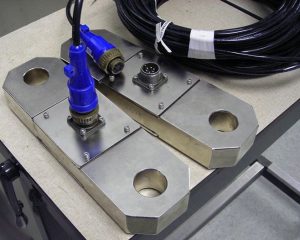
A tension load cell dynamometer sits in line with the rope and carry the full tension right through the sensor body. These are the workhorses for proof loading, load testing, and any application where the lift is a straight pull.
They’re also the usual basis for custom tension link work where the geometry is unusual.
Running Line Tensiometers
A floating running line tensiometer clamps onto the wire rope and measures tension by deflection. But the key thing about it is that it never enters the load path. That’s their whole argument – you can instrument a rope without having to modify it, on a machine that can’t be taken out of service.
But the trade off is that they measure rope tension rather than hook load – which are related but not the same on a reeved system.
Hanging Crane Scales
A hanging crane scale hangs below the hook and displays the weight – simple as that. And this is actually the right answer more often than engineers expect.
If all you need is to know what a load weighs, not to protect the crane, not to log data, not to talk to a PLC, a crane scale does that with no integration work at all.
Crane and Lifting Load Cells Characteristics
| Sensor | Headroom Cost | Installation | Breaks Load Path | Typical Use |
|---|---|---|---|---|
| Load Pin | None | Permanent | Yes — replaces pin | Crane modernization, hook block and sheave monitoring |
| Load Shackle | Small | Permanent or portable | Yes | Rigging, multi-point lifts, moves between jobs |
| Tension Link | Moderate | Permanent or portable | Yes | Proof loading, load testing, straight pulls |
| Running Line Tensiometer | None | Permanent or portable | No | Rope tension where modification isn’t allowed |
| Hanging Crane Scale | Significant | Portable | Yes | Weight readout below the hook |
Sizing Capacity: The Mistake Almost Everyone Makes
The instinct is to buy plenty of headroom. If the crane is rated for 20 tonnes, get a 50-tonne sensor and never worry about it.
This quietly wrecks your resolution. A load cell’s output is proportional to how much of its rated capacity you’re using. Run a 50-tonne cell at 5 tonnes and you’re working in the bottom tenth of its range, where the signal is small and the noise floor is exactly the size it always was.
Size the sensor to the loads you actually lift, then account for three things.
- Dynamic amplification: it happens when a load being hauled, suddenly yanked or swung up into the air produces a force that eclipses its static weight and this is what gets picked up by the sensor.
- Reeving: on any multi-part setup, the force going through the sheave pin isn’t the actual load on the hook. You’ve got to work out what the actual force is at the location of the sensor.
- Parts of line: If the rope uses several pulleys before it reaches the bearing point. Same with reeving the actual force at the location of bearing point must be computed.
Headroom Is Often the Deciding Factor
For a lot of overhead cranes this is the real showstopper. If you’ve already got the hook close to scraping the underside of the beam at maximum lift adding a tension link or any sort of crane scale below it means you’re losing that extra bit of height forever. On a plant crane losing 300mm of lift can mean that the load no longer clears the machine it used to clear.
That’s why load pins always dominate when it comes to permanent work on cranes. The reason is that they’re the only real option that gets you headroom back for free because they occupy a position the crane already had.
Wired or Wireless
Wireless has become the default for rigging sensors and for retrofits where cable routing is genuinely difficult, running a cable down a moving hook block is not a small job. Wired still wins where the sensor is permanently installed and feeding a control system continuously: no battery to manage, no radio path to protect. A practical compromise on modernization projects is to wire the permanent primary sensor and use wireless for anything that moves.
Getting the Output Right
This is where crane projects most often go sideways, because the sensor gets specified properly and the signal doesn’t. Massload’s crane and lifting sensors are available with mV/V, 4-20 mA, 0-10 V, 0-5 V, ±10 V, and ATEX options.
- mV/V is the raw strain gauge output, going to a dedicated indicator or transmitter. Most flexible, most sensitive to cable runs and electrical noise. If you’re not sure what the number on the datasheet means, start here.
- 4-20 mA is what a PLC almost always wants. Immune to voltage drop over distance, which matters on a crane where the run is long and the electrical environment is hostile.
- 0-10 V / 0-5 V / ±10 V suit specific controller inputs and shorter runs.
- ATEX applies where the lift happens in a classified area. It’s a specification decision, not an accessory.
Retrofitting a signal conditioner later is more expensive than getting it right once. Our companion article on crane overload protection and instrumentation covers what happens downstream of this decision.
Standard or Custom Crane Load Cell?
Most lifting applications are served by standard products that have been curated for the specific application. Shackles, tension links, tensiometers and crane scales cover an enormous share of real-world work with no engineering lead time at all.
Custom is necessary when the sensor has to fit an existing mechanical interface – which in practice means most permanent crane modernization work. A pin has to match the pin it replaces. There’s no off-the-shelf equivalent to that.
Why the Manufacturer Matters on a Lifting Sensor
A lifting sensor is not an instrument bolted onto a machine. It’s a structural component carrying a suspended load over people. That raises the bar well above just “does it read accurately” – you need to have documented material traceability, controlled strain gauging, and calibration that you can verify at an inspection.
Massload is the only Canadian company certified to manufacture load cells under VCAP certification, which means an independent agency audits our design, manufacture, and calibration every time, not once.
Frequently Asked Questions
Load pin or load shackle, which should I use?
It depends on whether the sensor stays put. A load pin is better for permanent monitoring on a specific crane, because it replaces an existing pin and costs no headroom. A load shackle is better when the sensor moves between lifts or machines, because it installs and removes like ordinary rigging hardware.
Do I need to know the crane’s capacity to specify a load cell?
You need it, but it isn’t the number you size to. Size to the loads you actually lift, allowing for dynamic peaks and reeving effects at the sensor’s location. A sensor sized to a nameplate capacity you never approach will spend its life reading in the weakest part of its range.
Can a load cell be added to a crane without affecting its rated capacity?
Yes, when the sensor is engineered for the position it occupies. A load pin is designed to match or exceed the mechanical specification of the pin it replaces, leaving the original load path and capacity intact.
The Fastest Way to a Short List
If you’re weighing up options for a crane or lifting application, the fastest route to an answer isn’t a catalogue, it’s a conversation about where the load can physically be measured on your machine.
Our technical application team can work through your crane’s geometry, reeving, and control system.
For background on retrofitting older equipment, see material handling and crane modernization. Browse the full range of crane load cells and lifting sensors, or contact us.
RELATED PRODUCTS