If you walk into almost any plant, mill, or port facility in North America, you’ll find a crane that’s older than the people operating it.
That in itself is often not a problem, overhead cranes are meant to last for decades, and the structural steel usually ends up outlasting just about every bolted component on it.
It’s what’s going on with the load monitoring that tends not to age so well: mechanical dials that are prone to wandering off their mark, old analog systems where the parts that need replacing aren’t even made anymore, or no real-time weight measurement at all.
Trying to replace the whole crane just because the load gauge went bad can actually be consider an unnecessary expense. The smarter move is crane modernization: keeping the mechanical structure that’s proven itself time and time again, and giving it a much-needed upgrade with modern load cell tech.
When Is It Time to Modernize?
Look for these signs:
- The crane’s 25-30+ years old: The structure’s probably still okay but the electronics are almost certainly shot. When a legacy load indicator decides to pack it in, the replacement part’s often obsolete, and the crane just sits idle while someone tries to track down the part they used to make.
- Your lifting demands have changed: If you’re lifting heavier or more often than the original design was expecting, having a solid load measurement is how you know you’re still operating within the crane’s limits.
- There’s no load protection: Many old systems just display the weight, but don’t do anything about it – no trigger point, no relay, no automatic shutdown. Just an operator staring at a dial and trying to keep up with everything else.
- An inspection threw up some red flags: Whether you’re under Canadian standards like CSA B167 or OSHA requirements in the US, load monitoring gaps are among the most common – and easiest to fix – things that get flagged up on older cranes.
- You’ve got no load records: Maintenance planning and inspection are increasingly expecting some level of load history. A crane with no data trail is one that you’re flying blind.
What Crane Modernization Actually Means
Modernization doesn’t mean scrapping the crane. The structure, the runway, and the hoisting machinery stay put. What changes is the system measuring load:
- A modern load sensor gets installed at a load-bearing point – most often the hook block or a sheave pin.
- Instrumentation turns the signal into something actually useful: a live display, an overload alarm, a 4-20mA signal to the PLC or logged data.
- Calibration ties the whole system to a solid reference point, so you know you can trust the readings.
If you want a deeper look at how a load cell system all fits together, take a look at how to build a load cell weighing system from scratch. The fundamentals are the same on a crane, the main difference is where the sensor lives.
The Core Technology: Custom Load Pins
Most cranes already contain the perfect location for a sensor, they just don’t know it yet.
Every crane has load-bearing pins: in the hook block, in the sheaves, at equalizer points. A custom load pin swaps one of these out for a dimensionally identical pin that’s got strain gauges machined and sealed inside. No need for brackets or lost headroom or any of the rest.
Good integration points:
- Hook block pins: the most direct readout of what’s on the crane;
- Sheave and auxiliary sheave pins: load’s going through the reeving, where you can’t just modify the hook block;
- Equalizer and dead-end points: rope tension at fixed anchors;
Each pin is engineered to match the original exactly, that means same diameter, same length, same retention.
The crane doesn’t adapt to the sensor. The sensor adapts to the crane.
When a Load Pin Isn’t the Right Fit
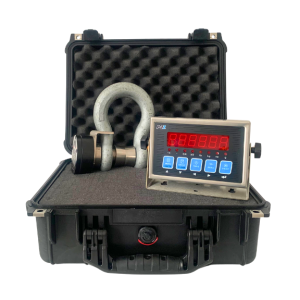
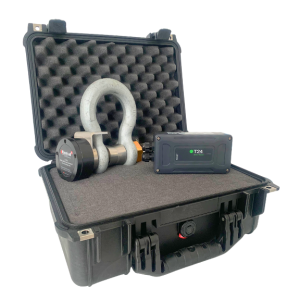
For many lifting tasks, standard crane load cells curated to the application do the job with no engineering lead time: wireless load shackles that drop into the rigging, tension load cell dynamometers for load testing and proof loading, and running line tensiometers that clamp onto the wire rope without touching the load path.
A good modernization plan usually mixes both: a permanent load pin for primary monitoring, plus standard sensors for rigging, testing, and portable use.
Why Manufacturing Quality Matters More in Modernization
When you’re modernising a crane, the load pin becomes a structural component because- it’s carrying the load, not just hanging off it. That makes it a whole lot more demanding of the manufacturer: you want documented material traceability, controlled strain gauging, and verified calibration.
Massload is the only Canadian company certified to manufacture load cells with VCAP certification, which means an outside agency checks up on our design, manufacture, and calibration every single time.
Frequently Asked Questions
Does adding a load pin change the crane’s rated capacity?
No, a proper load pin is engineered to either match or beat the mechanical specs of the old pin, making sure the original load path and capacity are still in place.
How much downtime does a retrofit require?
Most engineering happens off the crane. On-crane work — the pin swap, connection, and commissioning under load — is typically measured in hours or days, not weeks.
Start With the Measurement Point
Every modernization project starts with the same question: where does the load need to be measured, and what should the system do with that information?
Our technical application team can walk through your crane’s geometry and design a solution around the equipment you already own.
Explore our material handling and crane modernization applications or contact us to start the conversation.