Almost every lift already has a shackle in it. A load shackle turns that shackle into a measurement point, so the crew can see the actual force on the rigging during the lift, without adding a new piece of hardware or changing how they rig.
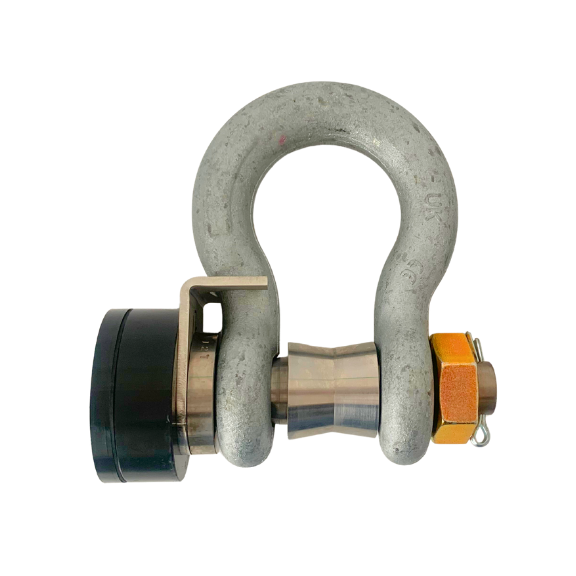
What is a load shackle? A load shackle is a standard bolt-type rigging shackle whose pin has been replaced with a load pin: a stainless-steel pin with strain gauges sealed inside it.
When the shackle takes load, the pin deflects very slightly, the gauges convert that deflection into an electrical signal, and a display, PLC or computer reads it as tension.
Because it fits wherever a normal shackle would, a load shackle adds load monitoring to a lift with almost no change to the rigging. Load shackles come in two versions: wired, with a cable to an indicator or control system, and wireless, with a battery-powered radio transmitter mounted on the shackle.
This guide covers how load shackles work, where they’re used, how wired and wireless versions compare and how to size one from published capacities.
If you already know you need one, you can go straight to Massload’s range of load shackles.
How a load shackle works
A load shackle has five main parts.
| Part | What it does |
|---|---|
| Shackle body (bow) | A standard bolt-type anchor shackle. It carries the load exactly as it would in any other lift, and its working load limit still applies |
| Load pin | Replaces the shackle’s normal bolt. Strain gauges are bonded inside a bore in the pin and sealed in. On Massload shackles the pin is 17-4 stainless steel |
| Bobbin | A stainless-steel spool on the pin that centres the load, so the force always lands on the same part of the pin |
| Keeper plate and wire lock pin | Stops the load pin rotating, which keeps the gauges aligned with the direction of pull. The wire lock pin makes assembly and removal quick |
| Electronics | On a wireless shackle, a sealed HDPE enclosure with the transmitter, internal antenna and batteries. On a wired shackle, a cable to the instrument |
The measuring principle is shear. When the shackle is loaded, the force is created by tension between the bow and the pins / bobbins during pulling. The pin with bobbins carries the load and is supported by two opposing forces on both sides of the shackle, which in turn causes strain on the pin. The strain gauges inside the pin measure that strain in the steel, which becomes a small, proportional change in voltage.
On a wireless shackle, the electronics in the enclosure measure the change in voltage, digitize the reading and transmit it, so you never deal with the millivolt signal yourself.
Why orientation matters: the load pin is calibrated for force in one direction, through the centre of the bobbin. If the load pulls off-centre or sideways, the reading drifts, and the shackle’s own working load limit drops, just as it would for any shackle. The keeper plate and bobbin exist to prevent both.
What load shackles are used for
Load shackles suit any job where the force runs through a rigging connection and the crew needs to know what it is:
- Crane and hoist load monitoring: live load readings at the hook or at a lifting point, often with an overload alarm.
- Rigging and multi-point lifts: one shackle per lifting point shows how the load is shared between legs, which helps when the centre of gravity is uncertain.
- Proof-load and pull testing: verifying anchors, lifting lugs and equipment to a test load, with a recorded result.
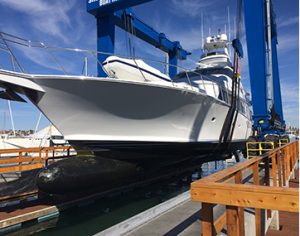
- Boat lifting and launching: weighing hulls on travel lifts and slings.
- Vehicle recovery and towing: measuring winch and recovery line forces so equipment stays within its rating.
- Line and wire rope tension: winch lines, guy lines, mooring lines and other static tension.
- Offshore and marine work: sealed to IP67 for wet environments.
Load shackle vs load pin vs tension link
All three measure force in the load path. The difference is where they sit.
| Load shackle | Load pin | Tension link | |
|---|---|---|---|
| Where it goes | In the rigging, in place of a normal shackle | In the crane or machine, in place of an existing structural pin | In line between the hook and the load |
| Headroom cost | Small | None | Moderate |
| Moves between jobs | Yes, easily | No, it’s permanent | Yes |
| Off the shelf | Yes, standard capacities | Usually made to match the pin it replaces | Yes, standard capacities |
In short, choose a load shackle when the sensor has to travel with the rigging crew, a load pin when the installation is permanent and headroom is tight, and a tension link for straight pulls and load testing.
Our guide to how to select the right sensor for overhead weighing compares all five crane sensor types in more detail, and if you’re upgrading an existing crane, our article on crane modernization explains where load pins come in.
Wired vs wireless load shackles
Massload builds the same load shackle in both versions. The shackle body, load pin and rated capacities are the same. What changes is how the reading gets from the shackle to the person or system that needs it.
| Wireless load shackle | Wired load shackle | |
|---|---|---|
| Signal | 2.4 GHz digital radio to a T24 receiver | 1 mV/V analog signal on a cable, or a conditioned signal from an inline module |
| Power | 2 AA batteries in the shackle | 5 V excitation from the connected instrument |
| Range | Up to 800 m free field, with the receiver 3 m off the ground | Limited by cable length |
| Battery life | About 500 hours of continuous use (roughly 2 months at 8 hours a day), with remote power-down | No batteries to manage |
| Readouts | Handheld displays, PC base station, 4–20 mA receiver, relay receiver, Modbus gateway, serial output to remote displays | Indicator, DIN-rail transmitter, analog output module, USB to PC, or a wireless transmitter |
| Set-up time | Minutes: rig it, switch on, read | Longer: route, protect and terminate the cable |
| Cable risk | None on the shackle, so nothing to snag, crush or wear through on a moving hook | The cable has to survive the lift, the hook block and the site |
| Best for | Portable kits, rigging that moves between jobs, multi-point lifts, hooks where cable can’t be routed | Permanent installations feeding a control system continuously, sites with heavy radio interference, battery-free operation |
Choose a wireless load shackle when
- The shackle moves between lifts, cranes or job sites.
- Cable would have to run down a moving hook block or across a working area.
- You’re monitoring several lifting points at once. One handheld can display up to 12 shackles.
- The reading has to reach someone standing well away from the lift, such as a supervisor or a lift director.
Choose a wired load shackle when
- The shackle is a permanent part of the installation and feeds a PLC or control system around the clock.
- The site has heavy radio traffic or a lot of steel between the shackle and the receiver.
- Changing batteries isn’t practical, or the system must never go silent because of a flat battery.
Wireless doesn’t mean disconnected from the control system. A wireless shackle can drive a 4–20 mA PLC input, trip a relay at a set load, or report to SCADA over Modbus.
There’s also a middle option: a wired shackle connected to a wireless transmitter, for when the shackle needs a cable at one end but the reading still has to travel. A common approach on cranes is to wire the permanent primary sensor and use wireless for anything that moves.
Choosing your readout: load shackle configurations
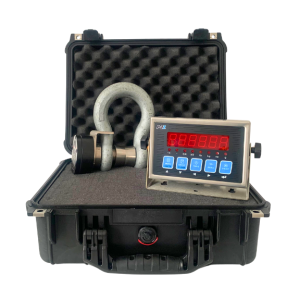
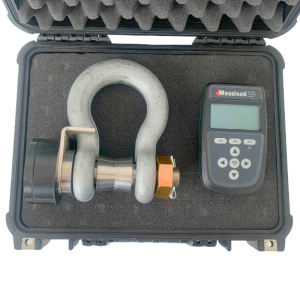
Usually, a Massload load shackle ships as a configuration: the shackle plus the instrument that suits the job.
| Product | What you need | Configuration | Notes |
|---|---|---|---|
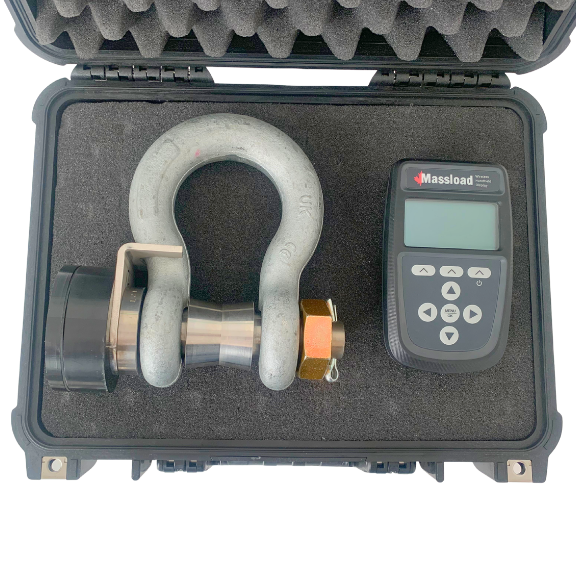 |
A live reading in the operator’s hand | Wireless Load Shackle to Wireless Handheld Display | Single-channel (WL-T24-HS) or 12-channel (WL-T24-HA) handhelds |
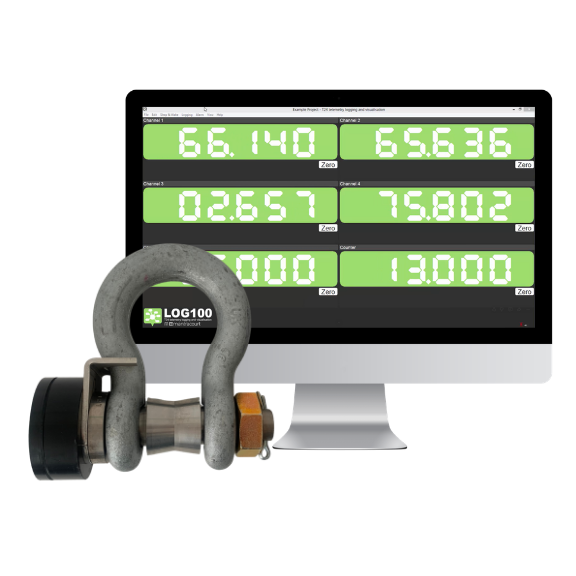 |
Recorded lift data on a PC | Wireless Load Shackle to Wireless Base Station to T24Log100 Software | USB base station (WL-T24-BSu) with free logging software |
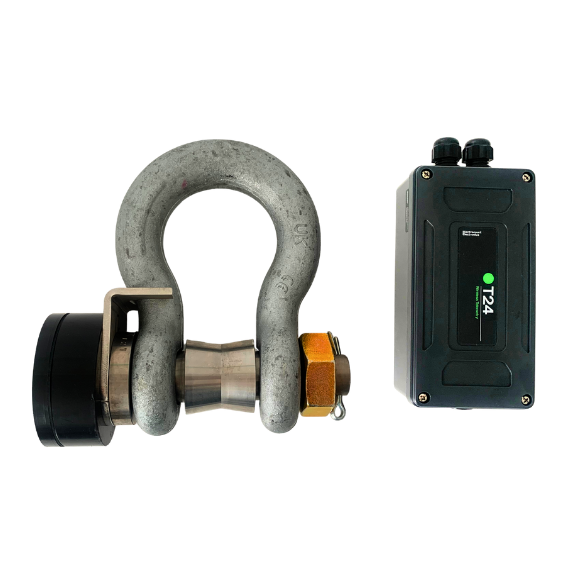 |
A 4–20 mA input to an existing PLC | Wireless Load Shackle to Wireless Analog Output to PLC | Receiver (WL-T24-AO1i) outputs 4–20 mA to the PLC |
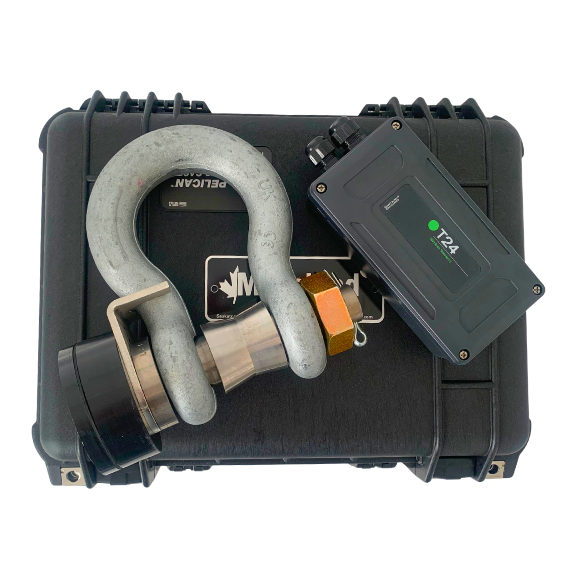 |
Live data in a PLC or SCADA system over serial | Wireless Load Shackle to Gateway | Modbus RTU or ASCII over RS232 or RS485 |
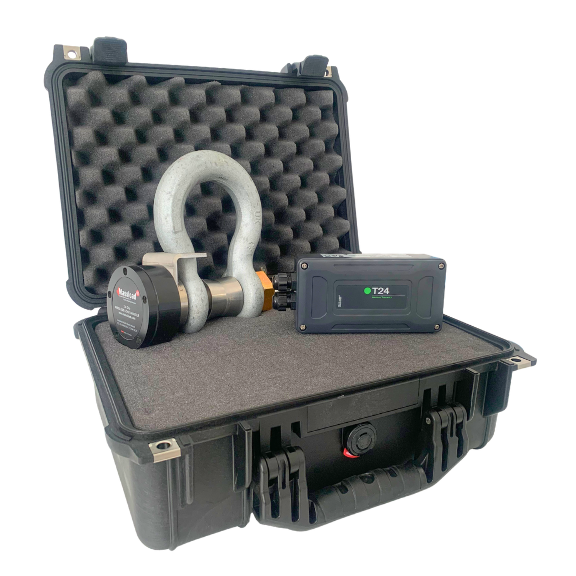 |
An alarm or cut-out at a set load | Wireless Load Shackle to Wireless Relay | Relay switches when the load crosses a threshold |
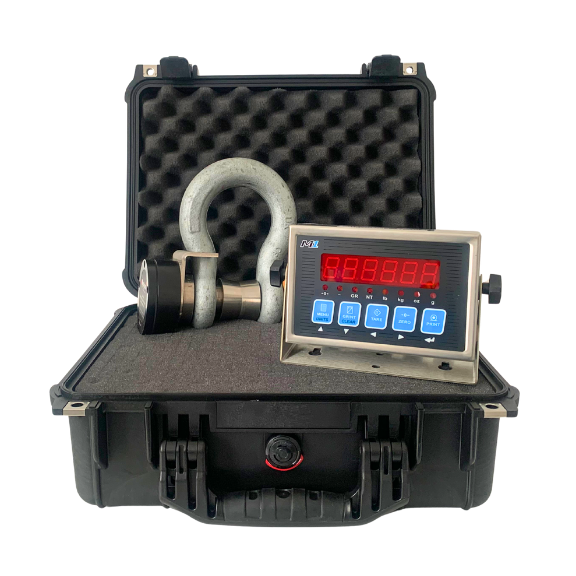 |
A digital readout on a cable | Wired Load Shackle to Indicator | Live reading at the lift point |
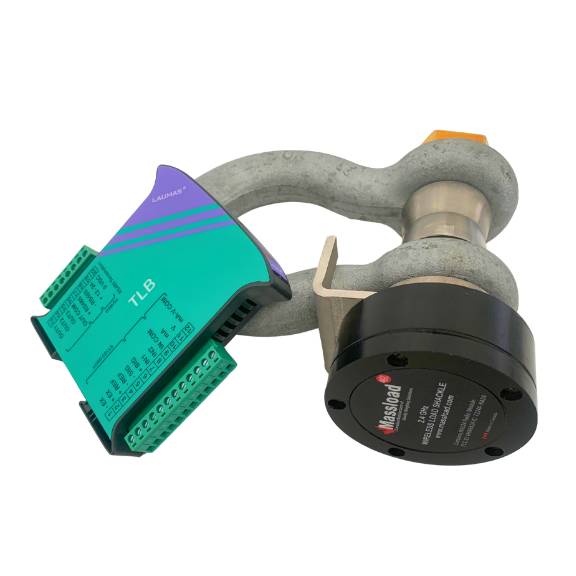 |
Fieldbus to a control panel | Wired Load Shackle to Transmitter | DIN-rail TLB (one shackle), TLB4 (up to 4 read individually) or TLM8 (sums up to 8). Modbus, Profibus, EtherNet/IP and Profinet |
 |
An analog signal straight to a PLC, no panel | Wired Load Shackle with Analog Output | Inline signal conditioner gives 4–20 mA or 0–10 V |
Other configurations include wired shackles to a computer over USB (fast or low sampling), a wired shackle to a wireless transmitter, and a wireless shackle to a serial output for large remote displays.
If you’re not sure which signal your system needs, our comparison of load cell output types explains mV/V, 4–20 mA and 0–10 V.
How to size a load shackle
Sizing comes down to five checks.
1. Work out the force through the shackle, not the weight of the load
On a single vertical lift, the force through a shackle under the hook equals the load plus any rigging below it. On a multi-leg lift it doesn’t. Each shackle carries its share of the load, multiplied by a factor that grows as the sling angle flattens.
2. Allow for dynamic loads
Lifting a load clear of the ground, stopping a hoist, wind and snatch loads all push the peak force above the static weight. Size for the peak, not the static weight.
3. Choose the smallest capacity that covers the peak
It’s tempting to buy plenty of headroom, but load shackle accuracy is quoted as a percentage of full scale, so an oversized shackle gives a less precise reading on the same load. Massload load shackles are accurate to better than 1% of full scale.
4. Understand the overload ratings, and don’t plan to use them
Massload load shackles have a safe overload of 150% of full scale and an ultimate overload of 300%. The safe overload is the peak the load pin can take without losing calibration. The ultimate overload is the point at which the pin could fail mechanically. Neither is working capacity. They exist to protect the measurement from shock loads, and the shackle body’s working load limit always applies.
5. Check fit and environment
- Fit: make sure the jaw width and pin diameter suit the hook, master link or lifting lug you’re connecting to, and that the bobbin will sit centred.
- Sealing: IP67, suitable for rain, washdown and temporary immersion.
- Temperature: the operating range is −20°C to +55°C, and readings are temperature-compensated from −10°C to +40°C.
For outdoor lifts in North America, that matters. Below −10°C the shackle still works, but expect slightly wider error. Below −20°C it’s outside its rated range, so talk to us before you plan the lift. Cold also shortens battery life on wireless units, so carry spare AAs.
Tips for using a load shackle
- Zero with the rigging hanging. Tare the reading with slings and spreaders attached but the load not yet lifted, so the display shows the load alone.
- Keep the load centred on the bobbin. Avoid side loading. If the shackle has to take an angled pull, check the shackle manufacturer’s side-load guidance.
- Keep the keeper plate and wire lock pin in place. If the pin rotates, the reading is no longer valid.
- Check the battery and the radio path before the lift. Line of sight gives the best range. Steel structures, containers and the load itself all shorten it.
- Inspect it like any shackle. A load shackle is still rigging hardware. Inspect the bow and pin before use and retire them if they’re damaged or deformed.
- Recalibrate on a schedule. Plan a recalibration interval that suits how hard the shackle works (we recommend once a year), and recalibrate after any overload event.
- Store and transport it protected. Portable kits travel best in protective cases.
Built and calibrated in-house, ready for your application
Massload’s load shackles are manufactured and calibrated in-house in Saskatoon through our VCAP-certified quality management system, the same way we’ve built load cells since 1981.
If you’re putting together a lifting kit or adding crane overload protection to an existing system, talk to our team and we’ll help you choose the capacity and readout that fit the job.
Frequently asked questions
What is a load shackle?
A load shackle is a rigging shackle fitted with a load pin, a stainless-steel pin with strain gauges inside. It measures the tension through the shackle and sends it to a display, PLC or computer, by cable or by radio.
How does a load shackle measure load?
The load passes through the pin, which deflects slightly in shear on either side of the bobbin. Strain gauges at those points convert the deflection into a small voltage that’s proportional to the load.
How accurate is a load shackle?
Massload load shackles are accurate to better than 1% of full scale. Because accuracy is a percentage of capacity, a shackle sized close to your actual loads gives a more precise reading.
What’s the difference between a load shackle and a load pin?
A load shackle is a complete shackle that moves with the rigging. A load pin replaces a structural pin in a crane or machine and stays there permanently. Load pins use no headroom; load shackles use a little.
Can a wireless load shackle connect to a PLC?
Yes. A wireless receiver can provide a 4–20 mA output, a Modbus connection through a gateway, or a relay that switches at a set load.
How far can a wireless load shackle transmit?
Up to 800 m in open field with the receiver about 3 m off the ground. Steel structures and obstructions reduce the range.
How long do the batteries last in a wireless load shackle?
About 500 hours of continuous use, or roughly two months at eight hours a day. The shackle can be powered down remotely between lifts, and it runs on standard AA batteries.
What capacity load shackle do I need?
Work out the peak force through the shackle, including sling angles and dynamic loads, then choose the smallest standard capacity above it. Massload’s standard capacities are 8.5, 12, 17, 25 and 35 t, with 55 and 85 t available to special order.
Can I monitor several load shackles at once?
Yes. A 12-channel wireless handheld can display up to 12 shackles, and a wired TLM8 transmitter can sum up to eight shackles into one total.